
Electrical Imaging & Resistivity (ERT)
Electrical Imaging & Resistivity (ERT)
Mapping the ground in detail, detecting anything from fine, shallow details to
larger structures hidden far below.
Bedrock profiling using imaging/ resistivity (Electrical Imaging & Resistivity) assists clients to:
- Ensure piling is securely installed
- Map the extent of oil pipeline and water leaks
- Locate the water table
- Provide evidence of fissures/caves/tunnels/ mines
- As a follow up to EM31 / CMD electromagnetic surveys to offer more information on key areas highlighted as part of the initial survey.
- Cross-reference borehole data with the survey results to offer a greater understanding as to their findings
Electrical Imaging and Resistivity
Below is an example of a Resistivity Survey. A full cross-section can be provided showing the contours and make-up of the ground reaching a depth of up to 30m into the ground.
The depths achievable are subject to how much space is available to lay horizontal lines of electrodes and the spacings available.
The closest together the spacings, the shallower the survey will penetrate, resulting in smaller features being detectable.
The deeper the penetration, the larger the features need to be in order to be seen in the data.
Want to know more about ERT?
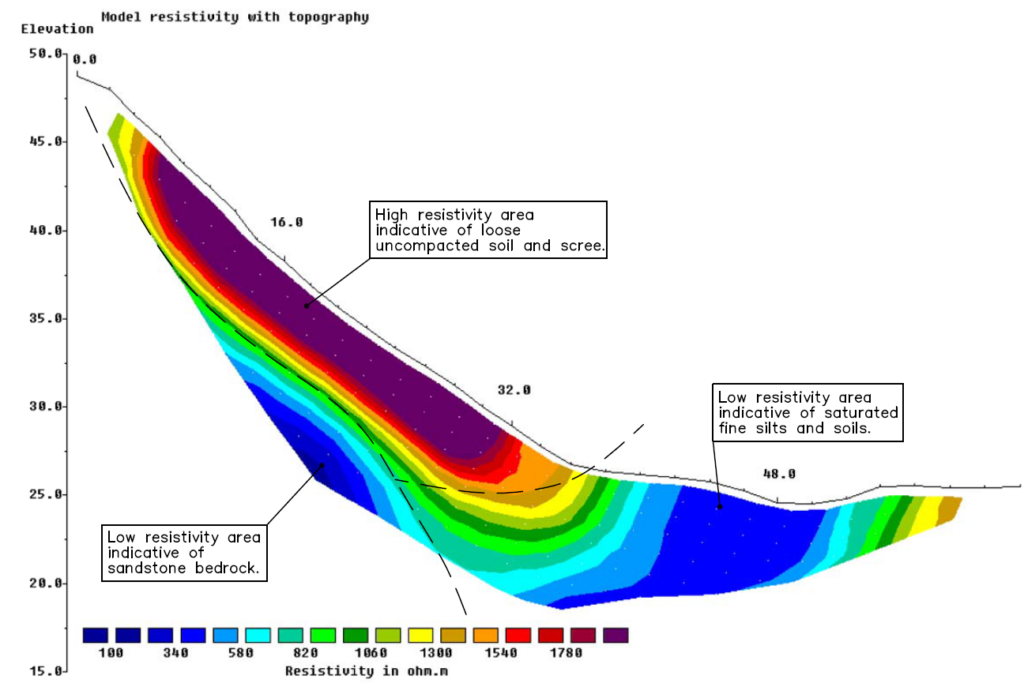
An Electrical Imaging and Resistivity (ERT) survey provides a cross-section of the ground, allowing the different subsurface layers to be identified. This process is commonly known as bedrock profiling and forms part of GEOTEC’s wider geophysical survey services.
The main objective of an ERT survey is often to determine the depth to bedrock, helping clients understand how deep foundation piles may need to extend.
ERT can also identify other layers and features, including landfill material. It may be used after an EM31 or CMD survey to provide greater detail about dissolution features.
GEOTEC has also used this technique to identify the extent of an oil-pipeline leak within a national park.
Electrical Resistivity can achieve a depth penetration of approximately 30m below the ground surface. However, sufficient open space is required to spread the electrode lines at the appropriate horizontal spacing.
An ERT survey is appropriate when a cross-section of the ground is required to identify its subsurface layers, such as the depth and profile of bedrock.
Electrical Imaging and Resistivity can meet a number of survey objectives and can supplement other geophysical approaches by providing greater detail about subsurface conditions.
The site must be suitable for the survey. The achievable depth depends on how far the electrode lines can be spread horizontally, so deeper investigations generally require large, open areas.
Resistivity surveys can also be time-consuming where electrodes need to be drilled into hard-standing surfaces.
Underground
Mapping
An example of a survey where Geotec have several unidentified ground penetrating radar targets present, as well as confirmed buried services and utilities.
This tool also allows Geotec to confirm the presence of metallic and conductive services that have already been detected through radio frequency detection / electro-magnetic locating (RFD / EML).
GPR Surveys
Electromagnetic Surveys
Talk to Geotec



Follow Online
© GEOTEC SURVEYS – UNDERGROUND MAPPING







Website Design & Development Hampshire – expect-more-creative.co.uk