
Geophysical GPR Surveys
Ground Penetrating Radar (GPR) is a versatile tool which can be used to meet a range of objectives:
- Buried services and utilities, in particular drainage, culverts and plastic pipes
- Changes in density relating to voiding or unconsolidated ground.
- The presence of subsurface features such as obstructions, tanks, pile caps and building lines
- Saturated ground conditions and wash associated with leaks
- Graves, crypts, tombs, basements and cellars
- Reinforcing and rebar in concrete slabs and concrete thicknesses
Geotec use a range of GPR antennae to search for features at a variety of depths to best meet your needs
- Handheld GPR system 0-450mm (below ground level)
- Shallow antenna 0-1m
- Standard antenna 0.1-3m
- Deeper antenna 2-10m
- Dual frequency antenna
Want to know more about Geophysical GPR Surveys?
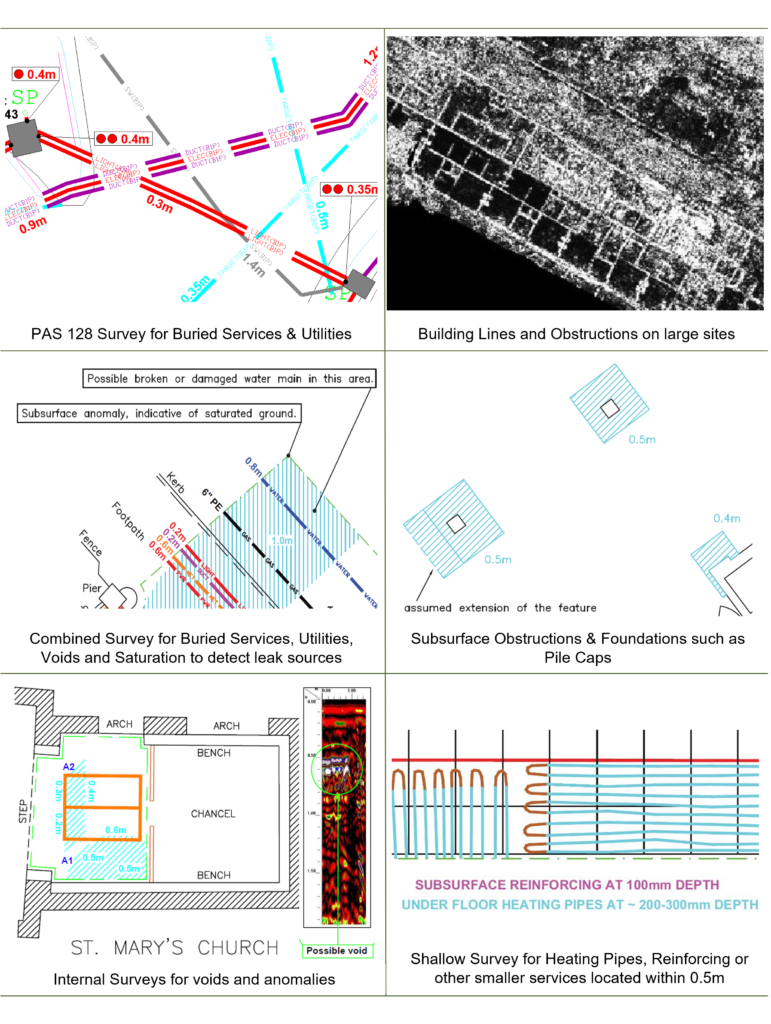
Geotec also use GPR when carrying out PAS 128 and buried services/utility mapping surveys as a matter of course, examples below:
Underground
Mapping
An example of a survey where several unidentified ground penetrating radar targets are present, along with confirmed buried services and utilities.
This tool also enables confirmation of the presence of metallic and conductive services that have already been detected through radio frequency detection/electromagnetic locating (RFD/EML).
Electromagnetic Surveys
ERT / Resistivity
A geophysical Ground Penetrating Radar (GPR) survey is a non-invasive investigation used to identify and map features beneath the ground surface.
GEOTEC regularly uses GPR to support buried-services and utility-mapping surveys, but the technology can detect much more than utilities.
GPR transmits radar energy into the ground and records reflections created by contrasts in subsurface materials. These contrasts can indicate changes in material, moisture content, ground condition or the presence of buried objects and structures.
GPR surveys can detect and help map a wide range of buried objects, structures and changes in ground conditions.
Depending on the site conditions and survey equipment, potential targets include:
- Buried services, utilities and drainage
- Buried tanks
- Changes in construction material
- Disturbed or unconsolidated ground
- Voids and cavities
- Saturated ground
- Cellars, basements and vaults
- Graves and crypts
- Foundations and former building lines
- Air-raid shelters
- Tunnels and other subsurface structures
GPR results are interpreted by experienced surveyors because the strength and clarity of a response depend on factors including the target material, size, depth and surrounding ground conditions.
The depth achievable with GPR depends on the antenna frequency, survey system, ground conditions, target size and the level of detail required.
GEOTEC selects the antenna, data-collection method and processing software to suit each application. Typical examples include:
- A 1.6GHz StructureScan Mini can investigate approximately the upper 450mm while providing excellent resolution for shallow applications such as concrete analysis and reinforcement scanning.
- 350MHz or 400MHz antennas are commonly used to detect and map buried services and utilities, often to depths of around 2m below ground level where conditions permit.
- A 100MHz antenna fitted to a suitable system may theoretically investigate to approximately 10m. GEOTEC has achieved penetration to 8m under suitable site conditions.
Depth cannot be guaranteed before a survey because conductive soils, moisture, made ground and other site conditions can restrict radar penetration.
A GPR survey is useful whenever more information is needed about features that may be concealed beneath the ground or within a structure.
Common reasons for commissioning a survey include:
- Before breaking ground when the position of buried services and utilities is uncertain
- When records, another survey, a desktop utility study or anecdotal information indicate that a subsurface feature may be present
- Where changes in ground colour, level or vegetation suggest a buried feature, depression or possible sinkhole
- Following a water leak or another event that may have removed soil or created underground voiding
- When a buried tank, foundation or other feature is known to exist but its precise location or depth is uncertain
- Whenever a non-invasive investigation could reduce uncertainty about below-ground conditions
Yes. GPR can detect plastic pipes, drainage runs and other non-metallic services where they create a sufficient contrast with the surrounding ground.
The likelihood of detection depends on factors including the pipe diameter, material, depth, contents, surrounding backfill, soil conditions, surface access and the antenna used. Because results are site-dependent, GPR is normally selected and interpreted as part of a wider survey methodology rather than relied upon in isolation.
Yes. GPR is one of the principal detection methods used during PAS 128 utility mapping surveys.
The appropriate antenna configuration and survey-grid spacing are selected in accordance with the required survey methodology and site conditions. GPR data is normally combined with electromagnetic locating and other evidence to produce a more complete and reliable understanding of buried services during an underground utility survey.
Talk to Geotec



Follow Online
© GEOTEC SURVEYS – UNDERGROUND MAPPING







Website Design & Development Hampshire – expect-more-creative.co.uk